


Buckley, Mary. “Women in the Soviet Union.” Feminist Review, vol. 8, no. 8, 1981, p. 79, https://doi.org/10.2307/1394929.
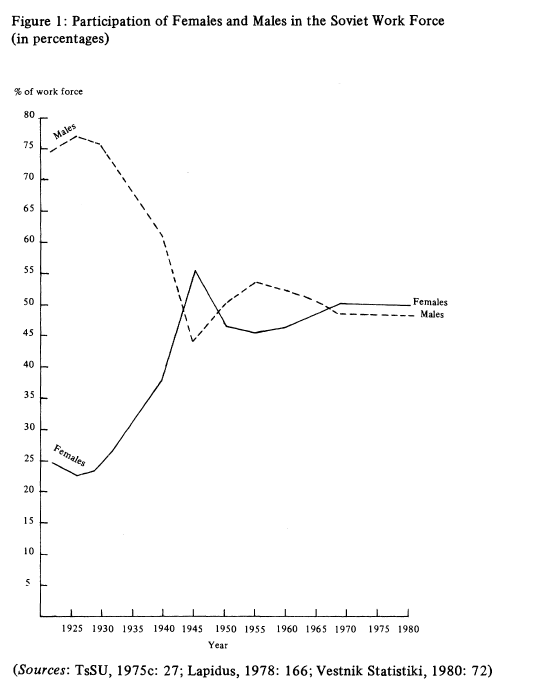
This paper provides a comprehensive overview of the history of women’s participation in the Soviet labor force, referencing the theory of Karl Marx and Vladimir Lenin while also citing past instances of female labor participation through penal labor under Peter the Great (circa 1719). Mary Buckley also covers the upholding of gender biases in this realm of female labor; in the late 1800s (during and right after the Industrial Revolution), Buckley states that female labor became “increasingly attractive” primarily due to its low costs, as “The norm was to pay women half, or slightly more than half, of the wage paid to men for identical work.” Figure 1 in this paper also provides a great insight into the participation of both females and males in the Soviet workforce; in 1945 (the last year of the Second World War), female labor participation exceeded male participation by ~12%.
Though this all seems to indicate that females enjoyed significantly increased working standards compared to other women in the world (from what I know), Buckley then introduces the issue of women in agriculture and industry and its continuing gender disparities. This involves similar abysmal pay, unskilled work, and abundant occupational segregation. This segregation is mainly present in rural areas, as Buckley states that in 1972, “Two-thirds of the women on state farms [were] field workers, of whom only 1.9% [were] engaged in mechanical labor.” This overviews the Soviet male/female achievement gap, especially in education and healthcare. Buckley states, “At a time when women made up 77% of the medical profession, they were 52% of head doctors…” along with saying that “While 71% of all teachers are women, 69% of secondary school directors are men, although 61% of their deputies are women” (these numbers come from 1980). This is because of the lower productivity and higher absenteeism of women, which is itself caused by traditional attitudes towards the role of women (women staying at home with their children when ill, pregnant, and on maternal leave).
Buckley then creates another section relating everything to women and household labor, first referencing political theory. Based on the works of August Bebel, Friedrich Engels, and Alexandra Kollontai, Buckley states that “Domestic enslavement or 'household bondage' was understood as one aspect of women's oppression deriving from capital.” This was because, according to Bebel, the oppression of women under capital and their material conditions worked in tandem with the oppression of women by dependence on men socially. Lenin went on to state that “petty housework crushes, strangles, stultifies and degrades [women], chains [women] to the kitchen and the nursery, and wastes [women’s] [labor].” However, Buckley presents evidence to prove that, unfortunately, Soviet society has not followed or embodied such principles perfectly (beyond labor conditions). Soviet facilities for childcare were relatively poor, with egregiously long waiting lists associated with construction lags and, as a result, an even higher demand for childcare. These facilities were also quite overcrowded and lacked sufficient supervision due to this demand, ultimately making women not want to go through such trouble and instead return to traditional standards of childcare, which would increase their work absenteeism, lower their pay (or stifle labor achievement), and continue the cycle.
Even though Engels and Lenin believed that “a change in attitudes toward women was essential, and that this would inevitably, almost derivatively, come about once capitalism had been overthrown,” these attitudes were still alive and well in Soviet society. These traditional views were not only echoed by men but also by women themselves. Buckley references two primary sources for this claim. First is a letter to a magazine concerning the matter of ‘bad wives,’ which states, "Girls must be brought up to be aware of their natural destiny as mothers, nurturers of children and keepers of the family.” The rest of the letter is riddled with similar rhetoric. The second source is a letter to Nedelia (a popular Soviet weekly newspaper that covered society, culture, and politics) from a thirty-four-year-old woman, which states that “It is more pleasant by far for a husband if he is welcomed home from work by a wife with a kind smile and a hot, tasty meal, than by a super-bright wife with a dissertation and dining hall ticket in her hand.” The rhetoric of both letters is nearly identical, but Buckley mentions that letters contrasting such sentiment were also printed. However, those ideas were not the majority opinion in Soviet society.
One would expect the birth rate to be relatively high if keeping up with traditional standards in the Soviet Union. This was not the case, though, as Buckley argues that the pressures of a job and household labor made it overwhelming for women to have large families. The Soviet Union attempted to boost birth rates through provisions such as criminalizing abortion under Josef Stalin and increasing obstacles involved in seeking a divorce, also under Stalin. This also came with national recognition; Buckley states, "Women were awarded the title of Mother Heroine if they gave birth to, and brought up, ten children, " with other awards granted to women who raised five or more children. But, the birth rate continued to fall. This is due to the dilemma involving gender roles that Buckley presents: “Under current conditions, it seems that the Soviet leadership needs two kinds of women: economically active ones to participate in the labor force, and economically inactive ones to have large families. The dilemma is that it wants women to do both and theoretically be liberated simultaneously.”
Lastly, Buckley covers the political status of women in the Soviet Union. Because of their labor and household responsibilities, women lacked sufficient time to participate actively in politics. Even women who had the time to participate tended to remain at the bottom of the government hierarchy and had heavy constraints on upward mobility in this hierarchy. This is especially evident when analyzing the membership of the Communist Party, as there was a gross overrepresentation of males. To fight these injustices, some women advocated for women’s sects of the Party. Still, many argued against it, believing that such developments would create divisions in the working class and lead to ‘bourgeois feminism.’
Buckley now finishes her paper with an overview of what she has covered, with an overarching point: "The stress on the means to the achievement of communist ends has meant the postponement, even displacement, of some of these ends” (such ends being instant equality of sexes). Despite communist philosophy advocating for women's equality as a necessary aspect of proletarian liberation from the capital, it seems that either such philosophy has simplified the process to an extreme or that the Soviet government’s beliefs lacked a basis in communist philosophy.
Mary Buckley is a researcher affiliated with Hughes Hall at the University of Cambridge. She specializes in Soviet and post-Soviet politics, society, history, and foreign policy. She also taught about such topics at the University of Edinburg for 17 years. At the end of this paper, it is stated that “Mary Buckley is writing a Ph. D thesis for Vanderbilt University on ideology and Soviet women. She is also working on Islam in Soviet Azerbaidzhan [sic] and recently spent six months in the USSR staying in Kyiv, Moscow, and Baku.” From this, I have discovered more of her works that interest me. The journal this article was published in, Feminist Review, is published by SAGE Publishing. SAGE is a credible publisher; SAGE publishes more than 1,000 journals and more than 800 books annually. This paper was written in 1981, roughly eight years before the fall of the Soviet Union. As a result, this introduces a gap in the Soviet history of women during the rule of Mikhail Gorbachev that this paper fails to cover simply because of how early it was written. This means I must seek another piece of evidence to fill that information gap. This information gap is especially pressing because of the liberal, laissez-faire economic policies passed under Gorbachev’s rule that likely had an enormous impact on the financial status/participation of women.
Carnaghan, Ellen, and Donna Bahry. “Political Attitudes and the Gender Gap in the USSR.” Comparative Politics, vol. 22, no. 4, July 1990, p. 379, https://doi.org/10.2307/421970.
In its beginning paragraphs, this paper is mainly based on a survey of 2793 Soviet women and their attitudes towards different aspects of politics. Carnaghan et al. introduce more recent (in terms of 1990) ideas that women are more apathetic towards politics or more politically intolerant. However, they also cite that American studies imply women are more likely to support the Democratic Party and, as a result, support social welfare programs and oppose increased military spending. Many cite biological differences between men and women as the reason for this divide, claiming that “biology is destiny.” However, Carnaghan et al. argue that this fails to account for social conditioning and the heavily social aspect of traditional gender roles that lack basis in biology.
Carnaghan et al. now introduce the idea of gender differences in attitudes in the Soviet Union. Although all Soviet leaders claimed they had achieved equality for women, Soviet theorists began to realize that was not the case. Carnaghan et al. also argue that glasnost, a " transparency " policy introduced by Mikhail Gorbachev, exacerbated this gender inequality. However, data on Soviet women’s political attitudes is (at least, during 1990) limited compared to the abundance of research on Western women. Thus, Carnaghan et al. also want to draw some parallels between Soviet and Western women to make up for this lack of information. A parallel drawn by them involves the mechanisms of gender, as traditional roles of women seemed similar in both regions. However, because of the rise of feminism in the Western areas due to similar conditions, such as increased workforce participation, it could be safe to assume that positive attitudes toward feminism are/were prevalent in the Soviet Union. This paper and Buckley agree that occupational equality was not achieved in the Soviet Union, perhaps limiting the spread of such feminist ideas.
Now, a survey from the Soviet Interview Project is introduced. Carnaghan et al. notice some limitations; although the survey had many respondents and questions, the sample did not seem random, as 85 percent were Jewish, and most came from urban areas. From this data, Carnaghan et al. state that “both men and women with a college degree and those who came of political age after the Stalin period [were] more inclined toward a feminist viewpoint than [were] their older or less educated counterparts.” This introduces the variables of age and education into political attitudes. Additionally, in contrast to popular belief, this study found little correlation between support for social welfare and gender. However, they did find that women were less supportive of state control of industry, medicine, and agriculture, likely noting dissatisfaction with the state socialist government of the Soviet Union. Women also seemed more inclined to favor lower military spending on matters such as aid for the Allies in World War II, aid to Northern Vietnam during the Vietnam War, and 1968 intervention in Czechoslovakia. Another variable found is feminism, which deeply splits women's opinions. Women interested in feminism were/are “more interested in politics, more tolerant, more in favor of state control of the economy, and somewhat less opposed to higher defense spending.” Women with younger children also seemed to be more inclined towards feminist beliefs. Also, women in the Soviet Union, surprisingly, did not feel that they were discriminated against in education.
In conclusion, the attitudes of Soviet women seemed to be similar to those of Western women. However, some women did not fit this mold, which was in correlation to age, education, and, as a result, inclination to support feminism/hold feminist beliefs. This establishes a remarkable parallel between Soviet and Western women but cautions against generalizing all Soviet women to hold traditional beliefs as a majority.
Ellen Carnaghan received a Ph.D. in political science from New York University and teaches at St. Louis University, a private and accredited research institution. Donna Bahry is a Professor Emerita of Political Science at Pennsylvania State University and earned a Ph.D. in political science from the University of Illinois, Urbana-Champaign. Both authors specialize in Soviet and post-Soviet politics and public opinion. Comparative Politics is a journal sponsored, edited, and published by the City University of New York. This information leads me to believe that this paper's authors and publisher(s) are quite reputable. However, for an in-depth analysis of Western women’s attitudes, I must look at the sources cited for this paper. I am glad that it covers the 8-year information gap brought by Buckley’s paper.
Schuster, Alice. “Women’s Role in the Soviet Union: Ideology and Reality.” Russian Review, vol. 30, no. 3, July 1971, pp. 260–67, https://doi.org/10.2307/128134.
Written in 1971, the paper opens with the claim that “Nowadays, the Soviet Union leads the world in making use of the energies and talents of women,” which slightly contrasts with the views of authors Buckley and Carnaghan et al. Schuster cites this to be a result of communist ideology and its belief that the only path to female emancipation was through communism. She also cites the first Soviet constitution of 1918, which, in Article 22, established individual equality regardless of sex, race, or nationality. She also claims that Lenin advocated for the increased political participation of women so that they, en masse, would understand the inner workings of communism, especially the proletarian dictatorship. Schuster then argues that Stalin believed in similar principles, which also resulted in higher participation of women in the workforce and defense industry during the Second World War.
Similarly to Buckley, she mentions a “monopoly” in the medical industry; however, Schuster fails to immediately mention the imbalance women have in medical job hierarchies. However, she mentions this in the matter of women’s participation in government, as she states, “the higher reaches of the Communist Party have remained almost exclusively under male control.” She says that this is primarily because of traditional gender attitudes and women having to juggle household responsibilities with their careers. She also finally mentions a critique of Stalin and his views of women, referencing his abolishment of the Women's Section of the Central Committee of the Party. Critiques of the Soviet treatment of women also delve into the dilemmas mentioned by Buckley, as it seems that women were expected to be diligent caretakers at home while actively participating in the workforce.
Schuster now claims that “It is, therefore, at this point, dictated by the lack of respect for women in Russian culture, that the equality promised in the Constitution breaks down and the facts of daily Soviet life most sharply diverge from communist ideology.” Schuster evaluates this as a degeneration of the origins of Soviet Russia, referencing the ideas of Russian Revolution pioneer Vladimir Lenin and his concern for women's rights. Concluding her paper, Schuster solemnly reflects on such a situation, stating, “Indeed, in a sense, the position of many women probably has deteriorated because most women now have to work a double shift, one for the state and the other one at home for their husbands and families.”
Alice Schuster is/was an assistant professor of history at Staten Island Community College of the City University of New York. I have yet to find any recent information on Schuster. The Russian Review is a peer-reviewed academic journal based on the politics of the Russian Federation, the Soviet Union, and the Russian Empire (all not existing in the present day). It is published by Wiley-Blackwell, a highly reputable John Wiley & Sons business.